A sunlit boulevard with tall, elegant palm trees swaying, some of the oldest and most expensive stores in the city, crossroads, atmospheric theatres, the ghost of an antebellum New Orleans, The Ritz-Carlton, Sheraton, Marriott hotels, casinos, women wearing hair curlers like nobody’s bussiness, them sugar daddys driving slowly in fancy limousines, street vendors playing reggae tunes on improvised stereos, impatient tourists, shady looking individuals, four storey high buildings, neon signs, billboards and the red and yellow streetcars in the middle of everything – this is what Canal Street is mostly about.


It took me a while to find my pace on this crowded avenue, curious to see where it would take me and excited to discover that it is the starting point for all the major Downtown to Uptown avenues. And there I was, at the crossroads between Canal and Basin – a road that used to host the town’s red light district in the 1870s, commemorated through music by Louis Armstrong, Louis Prima, Miles Davis and many others – so much so, that it has become a jazz standard.

In 1807, the French surveyor Joseph Antoine Vinache conceptualized it as a water canal that would connect the Mississippi River, Bayou St. John and Lake Pontchartrain, but those plans never materialized, Canal Street becoming “the heart of downtown” and the widest boulevard in the United States (170 ft wide) to be called a “street”. By the mid 1880s, it was completely lit by electric lamplights, which makes it one of the first electrified avenues in the world.


Morover, in the early 1800s, Canal Street was a neutral ground separating the French and Spanish Creoles living in the French Quarter and the pure Americans from the other side of town who didn’t want to have anything to do with each other (in reality, married American men would seek for a certain kind of companions, African-American women living no further than the French Quarter in a practice known as “plaçage” ).

For those of you passionate about butterflies – nature’s most beautiful details – Canal Street has something called “Audubon Butterfly and Insectarium”, an outstanding museum dedicated to all bugs – in fact, it is said to be America’s largest collection of it’s kind. The visit is supposed to be fascinating, unfortunately we managed to climb the walls enough to catch a glimpse of it, enough to see a few brown Owl-eyed butterflies stuck between windows in what looked like a futile attempt to escape and a few others who were already dead. Aaaaaaaaaand that was pretty much it for us.


For those of you who love streetcars at least half as much as I do – buy a one time only ticket for only 1.25$ or a one day pass for 5$ and choose one of the five routes (The Riverfront, St. Charles, Cemeteries, City Park/Museums, Rampart/St. Claude). Because some cars have been registered with National Register of Historic Places, they must remain unaltered, which means no air conditioning; which means that you are in for an open windows, hair blowing, hat throwing, iconic ride. But let me ask you this: when was the last time you’ve had such an experience? Never? Seldom? Often? Whichever the answer, I think it’s still worth every second of this old-fashioned ride through old New Orleans.

For the culture freaks amongst us, Canal Street is home to some of the oldest theatres in the U.S. Saengers opened in 1927 as a silent movie venue and it was designed to recall an Italian Baroque courtyard (or “an acre of seats in a garden of Florentine splendor”, as advertisments of the day would describe it) and 150 lightbulbs shaped as constellations were attached to the ceiling. It also features a 2000 pipe Robert Morton organ, one of the largest ever built by the Robert Morton Organ Company in California and specially designed for the theatre. And we’re talking about an era when the highest price for a ticket at Saenger’s was only 65c.


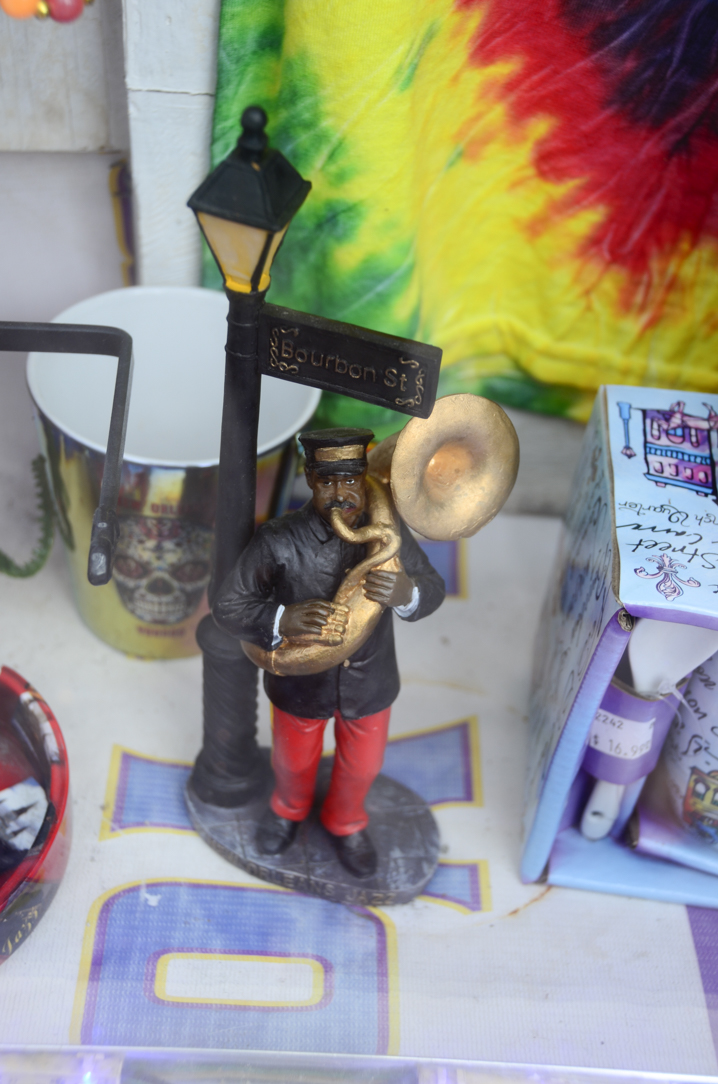


So, you see, Canal Street could easily be one of the most enchanting places you have ever seen and New Orleans, perhaps the most eclectic route you’ve ever taken with it’s rich history and neon displays, cotillions and debutante balls, “The Death Museum”, dangerous floodings, the memory of the Ku Klux Klan, Mardi Gras krewes, Loyola bus routes, hauntings, Adler’s Jewelery, festivals, revivals and…you, moving your feet to a rhythm only you can hear and looking down from a small window of a plane that takes you away and back to reality:

“Oh, when the saints go marchin’ in,
Oh when the saints go marchin’ in,
Oh Lord I want to be in that number,
Oh when the saints go…”
Green Eyed Kisses,
Error: No posts found.
Make sure this account has posts available on instagram.com.