
Oh, Chinatown! A beautiful mingle of misfits of all races (but still, mostly Taiwnese, Korean, Japanese, Filipino, Vietnamese, Kambodian, Nepalese, Thai and, of course, Chinese), a place for those with no identity, illegal aliens, poor individuals, adventurers, dreamers, lovers and seekers of a better life, but most of all, the best neighborhood for those who have the guts to share their raw, unbelievable life stories with complete strangers and then suffer the consequences.


After many hours of watching documentaries about Chinatowns prior to going to New York and having walked up and down Wardour Street in London every chance I got, I couldn’t help a certain feeling of “once you’ve seen one, you’ve seen them all”. And…in a way, I don’t think I was that far away from the truth. But still, somehow, I was a little disappointed to discover that there was no Paifang Gate for me to enter and exit through as I pleased anywhere in Chinatown New York. In a way, I felt robbed of a very simple joy and couldn’t get over it right away.


People actually call “a Chinatown” any territory outside of mainland China that is inhabited by Chinese people as a result of mass migration to the area. One of the oldest Chinatowns in the world is in Manila, Philippines; other examples are San Francisco and Melbourne.

So we knew we had to go through with the more touristical Chinatown, which is located in Lower Manhattan and then make our way to the real deal from Flushing, Queens.
We would have wanted to visit the Tenement Museum which was founded by Ruth J. Abraham and Anita Jacobson in 1988 and consists of two well-preserved tenement buildings that used to be home to about 15 000 people between 1863 and 2011 and continue to reflect the 19th and early 20th century living conditions through guided tours, documentaries, exhibitions, food tastings, neighbourhood walks and costume interpreters portraying the former residents and their lives as immigrants but, of course, there wasn’t enough time. I guess 97 Orchard Street remains a “must do” for the next time we come to the Big Apple.


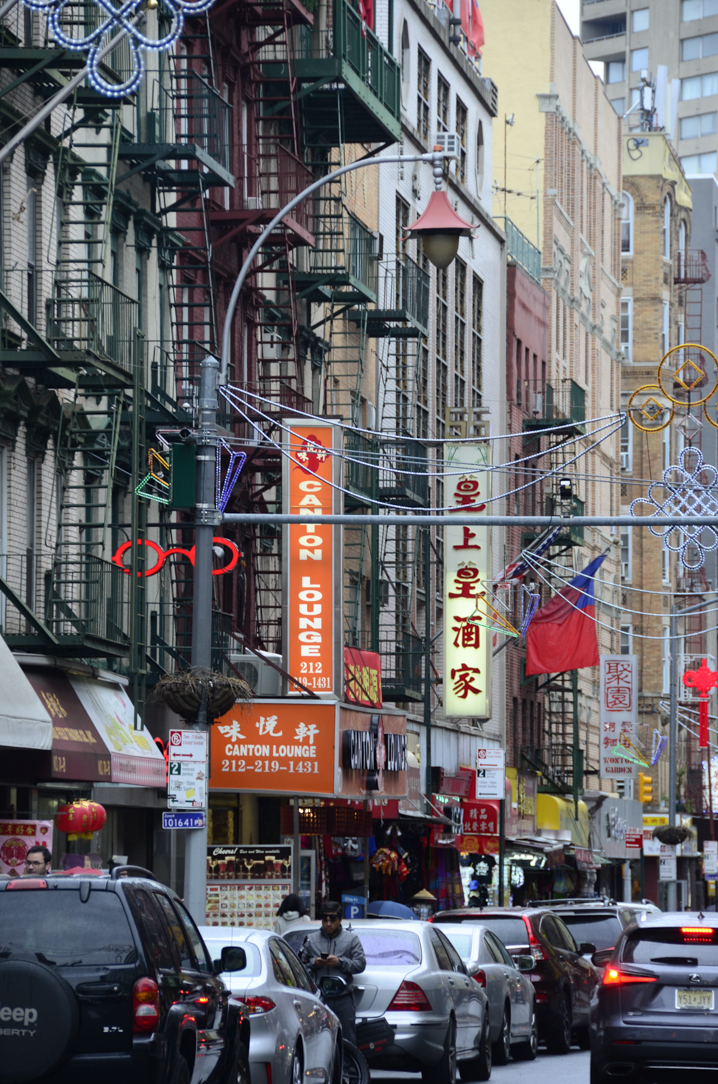
Instead, we started from 5th Avenue, stopped in Washington Square Park for some pictures and continued through NOHO until we reached a busy boulevard with building walls covered in grafitti, a huge Beyonce Homecoming poster hanging from another building wall, small souvenir shops, suffocatingly small restaurants, street sellers and other bazar-like establishments. We made our way through all of them and crossed the street to where the dumplings, pork buns, spices, dried fish, bubble teas, slurping noodles and all the other crazy things were.

But because my Paifang Gate was nowhere to be found (and because we though we didn’t have any money on us – long story), we decided to cross the Manhattan Bridge all the way into Brooklyn without trying any of the asian delights. And from that height, we got the best view over the crowded, cramped Chinatown sidewalks, better than we could have imagined possible.


Then we somehow made it to a Subway station and took the express <7> straight to the last stop – Flushing, Queens. And there it was: the intersection of Main Street, Kissena Blvd and 41st Ave. Crowded, confusing, maddening.

As the New York Metropolitan area is home to the largest Asian population (outside Asia) it was only natural that more than one Chinatown had emerged throughout the city. Today, there is an official estimate of twelve of them and there are around 30 000 China born individuals in Flushing alone, which is also known as “The Chinese Times Square” or “The Chinese Manhattan”. And thanks to the numerous traditionally Asian couisines that have been brought to this neighbourhood and stayed for many years (such as Taiwnese, Hakka, Shanghainese, Cantonese, Fujianese,Uyghur and Mongolian), this city area is considered to be “the Asian food mecca”. Unfortunately, Flushing is also said to have become the epicenter of organized prostitution in the USA.


But leaving all that aside, Flushing Chinatown is a great place for buying cheap fruits and vegetables (I’ve estimated it to be around 3 to 4 times cheaper than the Manhattan Chinatown) from places like the Hong Kong Market, to experience strong, strange cooking smells coming from the nearby suffocatingly small restaurants and maybe have a bite of Durian – if you dare.

And no, there is no Paifang Gate there either.
Green Eyed Kisses,
Error: No posts found.
Make sure this account has posts available on instagram.com.