“Not every album has to be completely unique or have a heavy concept behind it. […] I think the most important thing to aim for as a producer is to make something cinematic in effect, make the listener feel inexplicable feelings which is helped by the surreality of the music. Culture is so fast paced now that all this music is just passing noise, disposable almost and I like that aspect of it a lot. I love going on Soundcloud and just listening to the stream knowing that I will never hear these sounds again and they will just disappear into the wind” (Hong Kong Express)

In 2010, electronic music and the internet took a nostalgic trip down memory lane together and so was created v a p o r w a v e – a microgenre of music vaguely launched “somewhere, on the internet”, considered to be “anonymous art for anonymous people” because no one knows who, why and where exactly started the whole concept which owes much if not all of it’s existence to p l u n d e r p h o n i c s (audio piracy as a compositional prerogative).
According to John Oswald who coined the term in 1985, musical recordings themselves should be treated as a form of musical instrument, in which case v a p o r w a v e is safe from any possible copyright infringement accusations. Others insist that it is nothing more than a “glorification of stealing other peoples’ art and marketing it under something else”.
Some credits should be given to Daniel Lopatin, an american experimental electronic music artist with a focus on the noise subgenre better known for his Oneohtrix Point Never and Chuck Person aliases, for being a real inspiration to what we now call v a p o r w a v e. His music has been described as “serenity tinged with desolation” and one of his first attempts at v a p o r w a v e is “nobody here”, for which he used a heavily modified version of Chris DeBurgh’s “Lady in red”.
There are hundreds of valid definitions for v a p o r w a v e, but one of the most agreed upon theories is that it represents the combination of “vaporwear”, a concept used in the electronic industry to describe a software/hardware product which is announced to the public but never actually released and “waves of vapor”, a marxist term describing a perpetual repetition of ideas which are not meaningful in their philosophy.
The name’s spaced out stylisation is meant to create a dreamy effect and describe the slowed down nature of the art it represents.


Created through both audios and visuals, it is nothing less than an art movement meant to trigger powerful, nostalgic, unsettling yet sedating feelings for the 80’s and 90’s whilst ambiguously dealing with consumer capitalism and pop culture in the sense that it alternatively critiques and embraces them. The visual effects are generated through a redistribution of advertisments from the 80’s and 90’s, retrogaming, the twin towers, japanese lettering, soft pastels, airport bars, classic statues, apparent VHSesque low quality recordings, tropical landscapes, anime and 3D rendered objects;
whereas the profoundly melancholic audio effects are typically obtained by sampling 80’s and 90’s funk and soul tunes, elevator, supermarket and held calls music, start-up noises, text speech, dial-up, muzak, smooth jazz, lounge, R&B and dance tracks that are slowed down, chopped up and put together in a bizarre, distant atmospheric eerie sound meant to make the listener easily unconfortable yet strangely…seduceable.


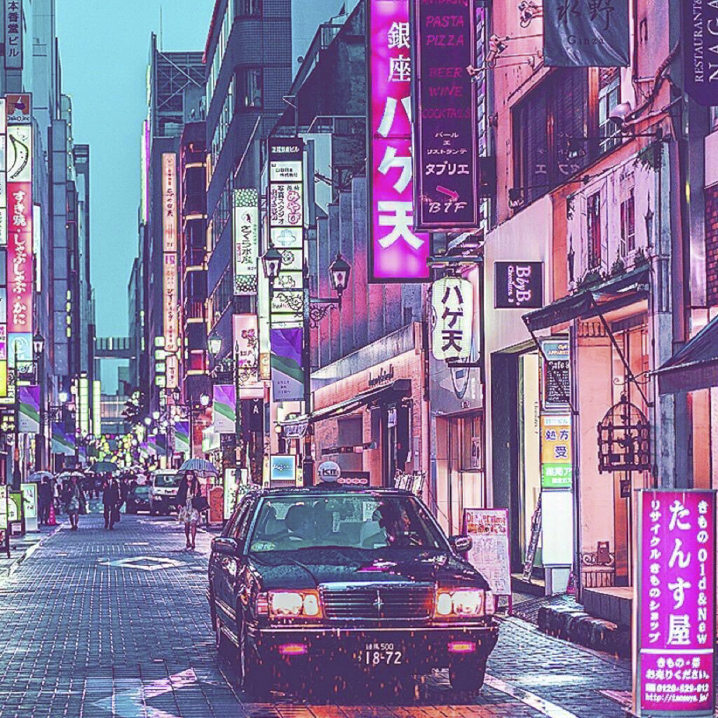
Thousands of pompous and condescending commentaries on v a p o r w a v e can easily be found all around the internet, stating that the focus should be on the phenomenology of the music itself – our personal experience with it versus what it is – in the “Apple-saturated, postmodern consumer world of the present”. Some have linked their experience to h y p n o g o g i a , the transitional state between wakefulness and falling asleep and hypnagogic pop (a genre of music which bases it’s whole existence on making it’s listeners fall into a prolongued hypnotic trance) which journalist David Keena described as “pop music refracted through a memory of a memory”. Others insist that timbre (the actual sound of music itself) influences our emotional response in music, in this particular case inducing intoxicating, persisting feelings of nostalgia.

One of the first v a p o r w a v e albums to have been produced is “Floral Shoppe”, released in December 2011 by Ramona Xavier aka Macintosh Plus and described by journalist Adam Harper as “chopped, glitching and screwed adult soul alongside twinkling spa promotional tunes”. Up to a few years ago, the track “Computing of Lisa Frank 420/Contemporary” featuring a slowed down version of Diana Ross’s “It’s your move” was unanimously considered to be the v a p o r w a v e international anthem.

During 2012 and 2013, the genre has suffered continuous alterations, becoming less interested in themes such as capitalsm and 80’s nostalgia. New artists emerged, each with a personal approach to the movement such as Skeleton (spooky sounding, slowed down songs), Blank Banshee (trap influence, heavy basedrums), Infinity Frequencies (a collection of strange, eerie, repetitive loops of elevator music reflecting a sense of emptiness and sterility and the souless existence of today’s technology), Echo Virtual (samples and original music mimicking the sounds normally heard on a weather channel and adding slow, droned out melodies), Hong Kong Express (a “mysterious, romantic trip through the neon haze of a night in Hong Kong, a journey of subway carriages and fast cars, a love both lost and found and a connection between souls”), Groceries (a collection of sounds normally heard in a run down grocery store, changing them to tell a “narrative of escapism and fantasy, a cruel realisation of hardships and monotony in a world that is constantly moving and changing”), Vaperror (creating dreamy beats using computer sounds as a drum kit).

The redefinition of v a p o r w a v e continued as an explosion of subgenres materialized into f u t u r e f u n k – an upbeat, funky groove with a v a p o r w a v e twist, influenced by n e w d i s c o, mixing contemporary music with futuristic sounds. It’s recognition as as it’s own genre came with the release of “Hit vibes”, an album by Saint Pepsi in May 2013.
Macross 82-99 took the genre a little bit further with “Sailorwave”, a collection of japanese disco songs remixed as an ode to Sailor Moon in December 2013 and Yung Bae (one of my favorite producers) released a collection of japanese pop songs mixed with drum’n’base and reverberations.
M a l l S o f t was described as representing the “glorification of utilizing elevator music as it’s main inspiration”, music that sounded as if it had been recorded in a shopping mall. In April 2013, Disconscious gained recognition by releasing a collection of 80’s funk tunes mixed with heavy reverb and treble reducer called “Hologram Plaza” popularizing the genre among different audiences. In October 2014, Corp‘s “Palm Mall” addressed the reality of shopping mall consumerism from a different perspective, once again drawing attention to modern capitalism.
In 2015, Vanity released his “Plaza” album in an attempt to (re)create sensations of late night wandering in solitude through an abandoned plaza, using drone out smooth jazz tunes and elevator music.
One of the most debated upon releases of the genre was “Floral Shoppe 2” created by The Darkest Future, a completely chaotic mix of sounds and effects meant to cause confusion and a feeling of uncertainty. It was later discovered that the whole album idea had been inspired by New Deluxe Life who “pushed the boundaries of experiementation to the point of becoming absolute crap, unlistenable”.


In 2015 Hong Kong Express and Telepath came with a new approach to the genre by creating “2814”, a dystopian concept album with all original music using drawn out chords, synthesizers and a heavy base track.


Personally, I have no intention of engaging in further philosophical or social analysis of the genre, because it would be missing the whole point. I am less interested in what the movement stands for on a global scale, whether it mocks the capitalist society or it was meant to popularize the concept and more intrigued about trying to define my own millennial experience with the music, searching for an explanation for feeling both young and old at the same time, for suddenly craving night time, solitude, a full orange moon over my head and a walk through 90’s Tokyo streets with my fuchsia walkman on (and an Arizona iced tea in my hand for no reason).
I still have no idea what v a p o r w a v e is, but I can feel it them moment I push play. And it’s enough for me.
Green Eyed Kisses,
Error: No posts found.
Make sure this account has posts available on instagram.com.